

Energy costs are an ongoing expense for every automated car wash. Pumps, motors, dryers, water heating equipment, lighting, and building systems all consume electricity or other energy sources throughout the day. When equipment operates for hundreds or thousands of wash cycles each month, even relatively small improvements in efficiency can add up.
For owners looking to operate a more energy efficient car wash, the challenge is knowing where to focus their attention. Replacing every piece of equipment isn’t necessarily the best approach. In many cases, the greatest improvements come from identifying systems that consume the most energy and making targeted changes that improve their performance.
We’ve spent more than 40 years installing and servicing car wash equipment throughout Western Canada, and we’ve seen how equipment condition, system design, and maintenance practices influence operating efficiency. Understanding where energy is being used is the first step toward making improvements that benefit both the business and its long-term operating costs.
Identifying the Equipment That Uses the Most Energy
Not every component in an automated car wash consumes the same amount of energy.
High-pressure pumps, electric motors, dryers, water heating equipment, and building heating systems are often among the larger energy users. Their actual consumption depends on the equipment, wash volume, operating settings, and local climate.
High-pressure pumps are a good place to begin. These systems require substantial power to deliver the water pressure needed for effective cleaning. If pumps are worn, poorly adjusted, or operating longer than necessary, they may consume more energy than the wash process requires.
Regular car wash maintenance helps make sure pumps are operating as intended. Worn components, leaks, restrictions, and incorrect settings can all affect performance and efficiency.
Drying systems are another area worth examining.
High-powered blowers can consume considerable electricity, particularly at busy locations. Proper positioning, airflow, timing, and control settings all influence how effectively the system removes water from vehicles. Our guide to rinsing and drying techniques covers this in more detail.
An inefficient dryer may run longer than necessary without delivering a noticeably better result. Reviewing the equipment’s operation can sometimes identify opportunities to reduce energy consumption while maintaining customer satisfaction.
Water heating and building heating also deserve attention, especially in Alberta and colder regions of British Columbia.
During winter, operators need to protect equipment from freezing while maintaining suitable operating conditions. Poor insulation, inefficient heating equipment, or car wash doors that remain open unnecessarily can increase energy costs.
Bay doors, heating controls, pipe insulation, and freeze protection systems should all be considered when evaluating overall efficiency. If you’re also looking at reducing winter downtime, these same checks do double duty.
The goal isn’t to reduce energy consumption at the expense of wash performance or equipment protection. It’s to make sure energy is being used where it provides the greatest benefit.
Read More: Designing a Car Wash for Canadian Weather
How Modern Motors and Controls Improve Efficiency
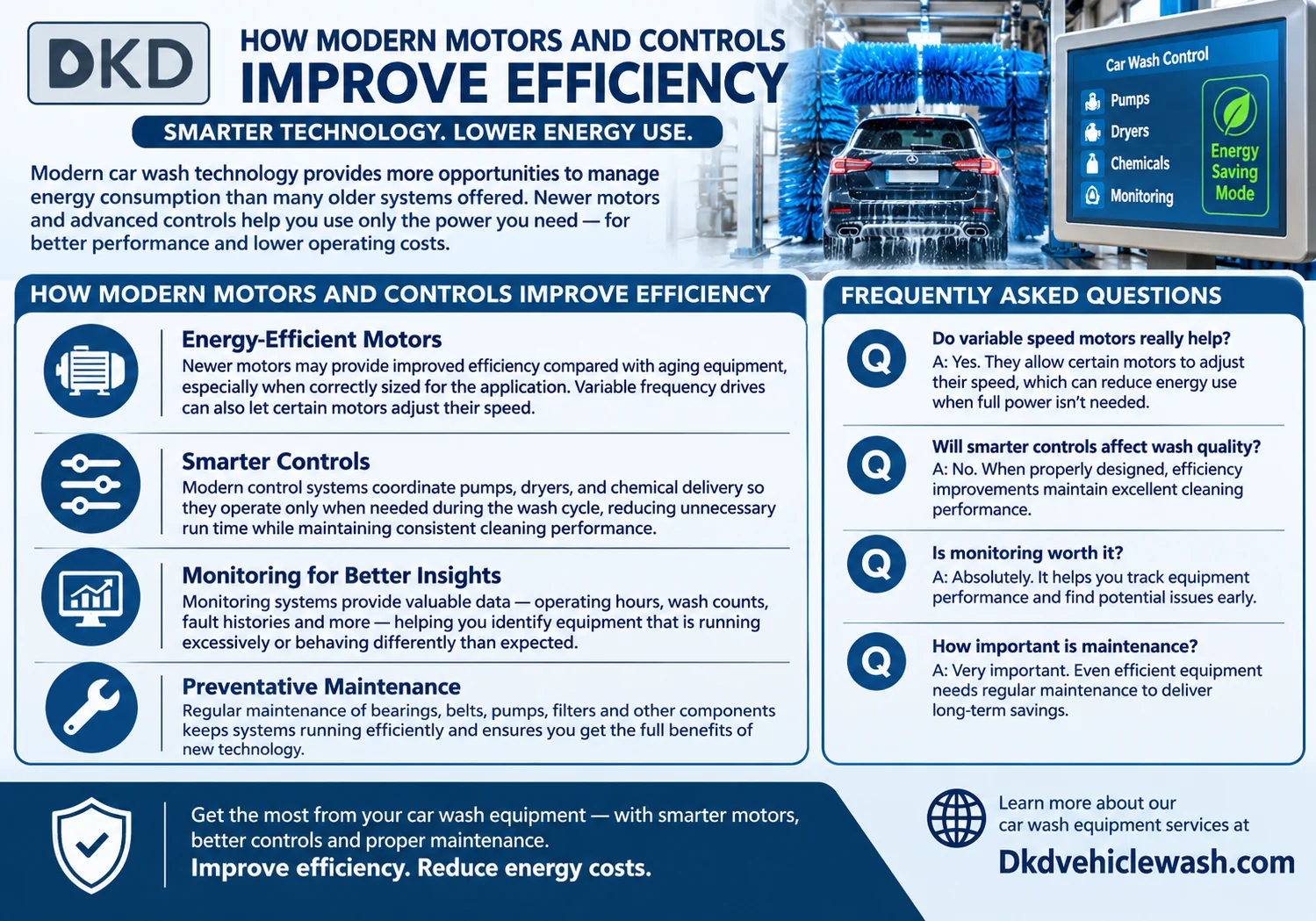 Modern car wash technology provides more opportunities to manage energy consumption than many older systems offered.
Newer motors may provide improved efficiency compared with aging equipment, particularly when correctly sized for the application. Depending on the system, variable frequency drives can also let certain motors adjust their operating speed rather than running at a constant output.
This can be useful where equipment demand changes throughout the wash cycle.
Not every motor or pump is suitable for variable-speed operation, though. Equipment needs to be evaluated carefully to make sure changes won’t affect water pressure, wash performance, or manufacturer requirements.
Automated controls can also help reduce car wash energy use by improving equipment timing.
Modern control systems, for example, can coordinate pumps, dryers, chemical delivery, and other equipment so they operate only when needed during the wash sequence. Better timing may reduce unnecessary run time while maintaining consistent cleaning performance. See the role of software in automated car wash systems for more on how controls work.
Monitoring systems can provide additional information about equipment operation. Depending on the technology installed, owners may be able to review operating hours, wash counts, fault histories, and other performance information.
That information can help identify equipment that is running excessively or behaving differently than expected, which is where modern car wash diagnostics can be especially useful.
Preventative car wash maintenance remains an important part of the equation.
Even an efficient new motor won’t deliver its intended benefits if the connected equipment is poorly maintained. Bearings, belts, pumps, filters, electrical connections, and other components need regular attention to keep systems operating properly.
We often remind owners that energy efficiency isn’t only about purchasing new technology. It’s also about making sure the equipment they already own is working as efficiently as possible.
Understanding the Return on Energy Efficiency Upgrades
When considering an upgrade, it’s important to look beyond the initial purchase price.
The real value of energy-saving equipment comes from how much it reduces operating expenses over its useful life. An upgrade that delivers modest savings on every wash cycle may produce meaningful benefits when multiplied across a busy facility.
The return on investment depends on several factors, though.
Equipment cost, installation requirements, energy rates, operating hours, wash volume, and expected maintenance expenses all influence the financial outcome.
Replacing an older motor may make sense, for example, if it operates for long periods every day and the new equipment offers a measurable efficiency improvement. The same investment may be harder to justify for equipment that runs only occasionally.
This is why we recommend evaluating actual operating conditions rather than relying on general claims about potential savings.
Utility bills can provide a useful starting point, but more detailed measurements may be needed to understand individual equipment consumption. Comparing energy use against wash volume can also help owners determine whether improvements are delivering meaningful results.
In some cases, relatively straightforward adjustments to equipment settings, maintenance practices, or operating schedules may provide a worthwhile improvement without major capital spending.
In others, replacing aging pumps, motors, dryers, or control systems may offer the best long-term value. Our guides on signs it’s time to upgrade and car wash equipment replacement planning can help you decide.
At DKD Vehicle Wash, we help owners evaluate their equipment and identify practical opportunities for modernization. Our focus is on recommending solutions that make sense for the facility, improve reliability, and support long-term operating efficiency.
An energy efficient car wash isn’t necessarily the one with the newest equipment. It’s the one where the complete system is properly designed, maintained, and operated to deliver consistent results without unnecessary energy consumption. For more ideas, see eco-friendly innovations for a more sustainable car wash.
If you’re concerned about rising utility costs or considering equipment upgrades, we can help assess your existing systems and explore improvements that make financial and operational sense for your business. Contact DKD Vehicle Wash today to discuss your equipment.
Frequently Asked Questions
1. What equipment uses the most energy in an automated car wash?
High-pressure pumps, motors, dryers, water heating equipment, and building heating systems are often significant energy users. The actual consumption depends on equipment design, wash volume, operating conditions, and climate.
2. Can newer motors reduce car wash power consumption?
Yes, in some applications. Modern high-efficiency motors can consume less electricity than older or inefficient equipment. Savings depend on motor size, operating hours, load, and the efficiency of the equipment being replaced.
3. Do automated controls help reduce energy costs?
They can. Modern controls may improve equipment timing, reduce unnecessary run time, and coordinate different components more efficiently throughout the wash cycle. Read more about software in automated car wash systems.
4. Is replacing older equipment always the best way to improve efficiency?
Not necessarily. Proper maintenance, equipment adjustments, improved controls, and changes to operating schedules may provide worthwhile savings without requiring a complete replacement.
5. How can I determine whether an energy efficiency upgrade is worth the investment?
Start by reviewing equipment condition, operating hours, utility costs, and expected savings. Comparing installation costs against realistic annual savings and maintenance benefits can help determine the potential return on investment.
6. How can DKD Vehicle Wash help improve energy efficiency?
We can assess existing automated car wash equipment, identify components that may be operating inefficiently, recommend appropriate maintenance or upgrades, and install modern systems designed to provide reliable performance and improved operating efficiency. See why car wash owners in Alberta choose DKD Vehicle Wash.

